
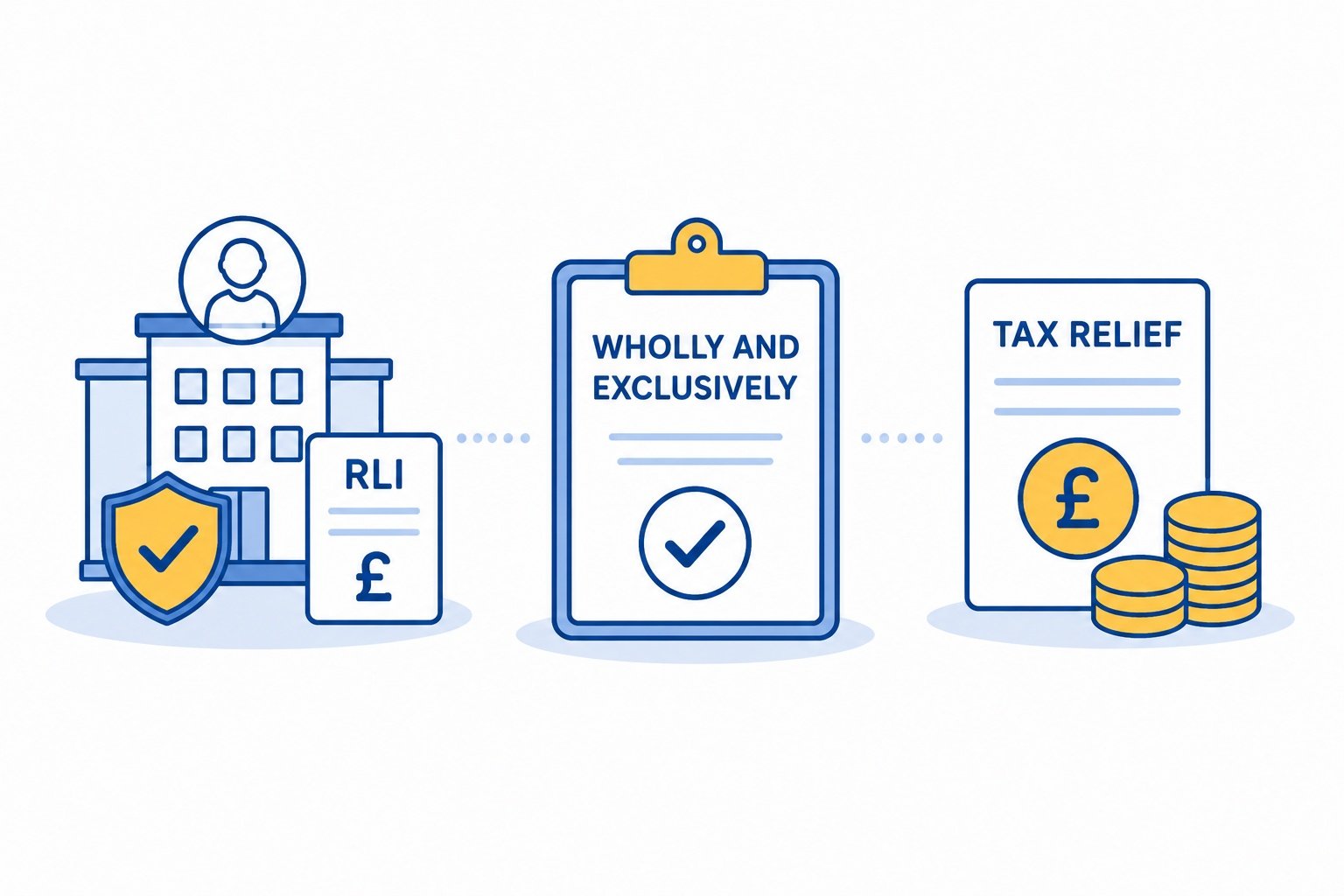
One of the most common questions company directors ask is whether premiums for relevant life insurance qualify for Corporation Tax relief.
The answer is usually yes.
However, unlike some other tax rules, there is no automatic entitlement to relief.
Instead, HMRC considers whether the expense has been incurred wholly and exclusively for the purposes of the company’s trade.
This is known as the wholly and exclusively rule.
If you’re new to relevant life insurance, start with our guide to what relevant life insurance is.
Relevant life insurance premiums will often qualify for Corporation Tax relief, but HMRC does not guarantee this. The company must be able to show that the policy has been taken out wholly and exclusively for the purposes of the business. The final decision always depends on the individual circumstances.
What does “wholly and exclusively” mean?
The phrase comes from UK tax legislation.
It is the test HMRC uses when deciding whether many business expenses are deductible for Corporation Tax purposes.
In simple terms, the expense must have been incurred for the purposes of the company’s trade.
If there is a significant personal purpose behind the expenditure, Corporation Tax relief may not be available.
HMRC explains the principle in its Business Income Manual.
HMRC Business Income Manual – BIM37007
How does this apply to relevant life insurance?
Relevant life insurance is designed as an employer-provided death benefit.
The policy is owned by the company.
The company pays the premiums.
The employee or director is the person insured.
Where the policy forms part of the employee’s remuneration package, HMRC will often accept that the premiums have been incurred wholly and exclusively for the purposes of the trade.
That is one of the reasons relevant life insurance can often receive favourable tax treatment.
You can read more in:
Why advisers rarely say tax relief is guaranteed
You may notice that insurers, accountants and financial advisers often use words such as “usually”, “normally” or “in most cases”.
There is a reason for that.
HMRC does not approve individual relevant life policies before they are taken out.
Whether Corporation Tax relief is available depends on the facts surrounding each company and each policy.
For that reason, professional advisers are careful not to describe the relief as automatic.
When might HMRC question relief?
There is no published checklist that automatically disqualifies a policy.
However, HMRC may look more closely at cases where:
- the policy does not appear to form part of a genuine remuneration package
- the arrangement appears to have a significant personal purpose
- the policy does not satisfy the conditions for a qualifying relevant life policy
- the paperwork has not been completed correctly
That does not necessarily mean relief will be refused.
It simply means HMRC may look more closely at the circumstances.
Does being a company director make any difference?
Not necessarily.
Many relevant life policies are arranged for owner-managed companies where the director is also an employee.
Provided the policy has been arranged correctly and forms part of the director’s remuneration package, the same principles generally apply.
Our guides to who can take out a relevant life policy and relevant life insurance for husband and wife directors explain more.
Does the policy still have to satisfy the HMRC rules?
Yes.
The wholly and exclusively rule is only one part of the picture.
The policy must also satisfy the legislative conditions for a qualifying relevant life policy.
For example, it must be an employer-arranged policy, provide death benefits and comply with the age 75 rules.
Our guide to HMRC’s rules on relevant life insurance explains those conditions in more detail.
HMRC also outlines the tax treatment of relevant life policies in its Employment Income Manual.
Employment Income Manual – EIM15045
What should directors do?
Most directors do not need to carry out a detailed tax analysis themselves.
Instead, they should make sure the policy has been recommended by a suitably qualified adviser and that their accountant is aware of the arrangement.
That helps ensure the policy is documented correctly and reflected appropriately in the company’s accounts.
You can also read our guides to how to set up relevant life insurance and does relevant life insurance appear on a P11D?.
Frequently asked questions
Does relevant life insurance automatically qualify for Corporation Tax relief?
No. Relief is not automatic. HMRC considers whether the premiums have been incurred wholly and exclusively for the purposes of the company’s trade.
What does wholly and exclusively mean?
It is the test HMRC uses when deciding whether many business expenses qualify for tax relief.
Why do advisers say premiums “usually” qualify?
Because HMRC considers each case on its own facts. Professional advisers cannot guarantee how HMRC would view every individual arrangement.
Where can I read HMRC’s guidance?
HMRC explains the business expense rules in its Business Income Manual and the tax treatment of relevant life policies in EIM15045.