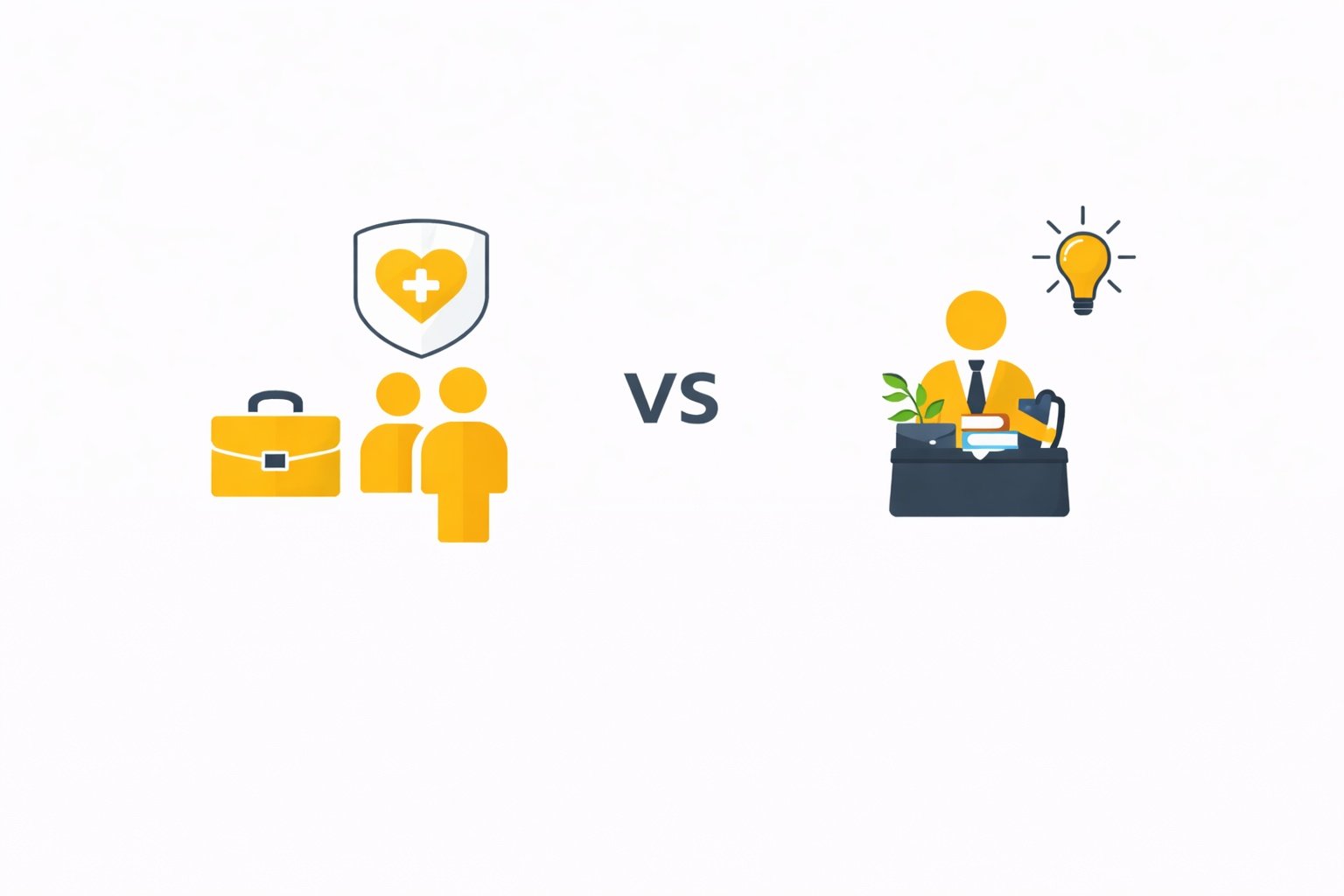
Relevant life insurance and key person insurance are often mentioned together, but they serve very different purposes.
Relevant life insurance protects an individual employee’s family, while key person insurance protects the business itself. Although both are forms of business cover, they differ in who receives the payout, how they are taxed, and why they are put in place.
Both protect the business, but the beneficiary, tax treatment, and reason for setting up each policy differ.
What is the core difference?
Relevant life insurance
Provides life cover for an employee or director, with the benefit intended for their beneficiaries.
- Company usually pays the premiums
- Policy is normally written in trust
- Payout is for the employee’s beneficiaries
Key person insurance
Protects the company against the financial impact of losing a key individual.
- Company owns the policy
- Payout goes to the business
- Designed to support business recovery
At a high level, relevant life insurance protects individual employees and their families.
Key person insurance is designed to protect the business itself.
That single distinction also explains most of the practical and tax differences between the two.
What is relevant life insurance?
Relevant life insurance is an employer-paid life insurance policy set up for an individual employee.
It pays a lump sum to the employee’s beneficiaries upon the employee’s death while employed.
The policy is written into trust from day one, keeping the payout outside the employee’s estate and avoiding inheritance tax.
Premiums are usually treated as a business expense, and there is no benefit-in-kind charge for the company or the employee.
Small companies and contractors often use relevant life policies because they are not large enough to run a group life scheme.
For a full overview, read What is relevant life insurance?
What is key person insurance?
Key person insurance is a business protection policy a company takes out on the life of a key individual.
This might be a director, founder, senior salesperson or technical specialist whose death would cause serious financial harm.
If the insured person dies, the payout goes to the company, not to the individual’s family.
The funds are intended to help the business survive disruption, cover lost profits, repay loans, or fund recruitment.
Unlike relevant life insurance, key person policies are generally not written into a trust.
The company owns the key person policy and controls the proceeds if the policy pays out.
Find out more at Key Person Help.
How do the tax rules differ?
Relevant life insurance is specifically structured to meet HMRC rules.
When set up correctly:
- Premiums are usually allowable as a business expense
- There is no income tax or National Insurance for the employee
- The payout is usually free of income tax and inheritance tax
You can read more here: Tax benefits of relevant life insurance
Key person insurance does not have a single, fixed tax treatment.
Whether premiums are tax-deductible and whether payouts are taxable depends on:
- The purpose of the policy
- Who benefits from the cover
- How the policy is structured
In many cases, premiums are not deductible as business expenses, but payouts may be tax-free.
You usually need professional advice before setting up key person cover.
Can one person be covered by both?
Yes, it is common for directors and senior staff to be covered by both types of policy simultaneously.
For example, a director may have:
- A relevant life policy to protect their family
- A key person policy to protect the company they run
These policies do different jobs and are not alternatives in that situation.
Which policy is right for your company?
Relevant life insurance is usually appropriate if:
- You want to provide a tax-efficient death benefit for an employee or director
- You are too small for a group life scheme
- The aim is family protection rather than business recovery
Key person insurance is usually appropriate if:
- The loss of an individual would threaten profits or survival
- The business has loans, investors or contractual dependencies
- The company needs direct access to the payout
Can you switch between the two?
Relevant life insurance and key person insurance are not interchangeable.
A policy set up as one cannot simply be converted into the other without cancellation and replacement.
That is why it is important to be clear about the objective before arranging cover.
Find out more / get a quote
If your goal is to protect an employee or director’s family in a tax-efficient way, relevant life insurance is usually the correct starting point.